The Lost Art of Letter Writing by Terry Moore
Recently, I read Selected Letters of John Updike. Okay, maybe I didn't read every page; I scanned quite a few. You see, it's a big book: 912 pages and containing approximately 700 letters. I was attracted to it because of my admiration for Updike, one of our finest American writers. Updike was also a favorite because he was a golfer and a sometime contributor to Golf Digest. Culled from a collection of over 25,000 (!) letters, the book traces Updike's remarkable career as a gifted novelist, poet, and critic. Amazingly, he never used email. All of his letters were typed or handwritten.
Incidentally, I found only one notable mention of golf, which fascinated Updike as a player and observer. In a letter to his son, he commented on his game and chipping.
Writing hard copy letters is certainly a lost art. Even handwritten thank-you notes are becoming increasingly rare, though they are still much appreciated.
It got me thinking about some of my past letters, particularly those related to my golf and writing career, which began in the Pre-Internet Age. These are a few of my favorites.
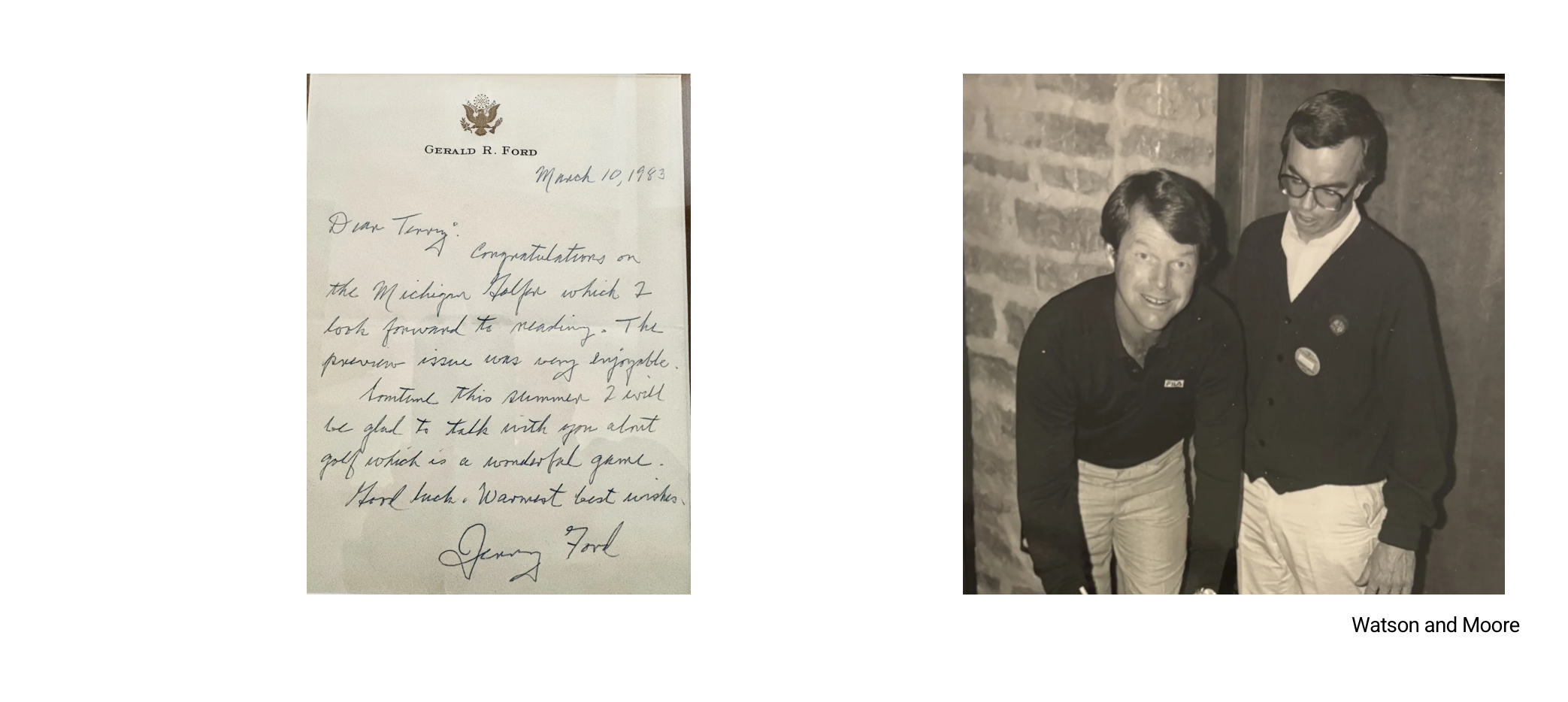
In February 1983, I wrote a letter to former President Gerald R. Ford at his office in Rancho Mirage, CA. In it, I presented President Ford with a lifetime subscription to Michigan Golfer and requested the opportunity to interview him about golf. As someone well known for always responding to constituent mail when he served as the Congressman for Grand Rapids, the President promptly replied in a handwritten note on his stationery, congratulating me on the publication and adding, "I will be happy to talk to you about golf, which is a wonderful game. (And yes, that summer I had an exclusive interview with Ford at his summer home in Beaver Creek, CO. That interview ended up as a long Q&A for our cover story to end our first publishing year.
In April 1983, I wrote a letter to Tom Watson's agent in Kansas City, MO, requesting a one-on-one interview with Watson at the Memorial Tournament in Columbus the following month. Knowing that Watson also was going to be the headliner at the one-day Grand Rapids Charity Golf Classic in late June, I figured I had a good chance. And it worked. Joined by Michigan Golfer writer Tom Cleary, we had a one-hour interview with Watson at the player's lounge at Muirfield Village. We asked Watson some offbeat and intriguing questions, which he enjoyed, and the resulting cover story helped put Michigan Golfer on the map.
In January 1984, I wrote a letter to the Masters Tournament requesting credentials to cover that year's Masters. I included copies of the publication and a most helpful recommendation from Jack Berry, the respected golf writer for the Detroit News. Fortunately, the Masters accepted my application, and I've covered the Masters ever since, except for the Covid years.
In March 1984, I wrote a letter to Herbert Warren Wind, the famed golf writer for The New Yorker, requesting to interview him during the Masters. He politely declined but welcomed my company at Augusta. I followed up the next month, had a delightful chat, and started a small friendship with the kind-hearted writer.
In March 1988, I wrote a letter to Maurice Flitcroft, the unemployed crane operator in England who was infamous for shooting a score of 121 in an Open Championship qualifier in '76, setting a record and becoming a folk hero to many. I invited him and his wife to Grand Rapids, all expenses paid, to play in a one-day tournament named in his honor at Blythefield CC. That letter and his appearance in Grand Rapids served as the basis for the acclaimed 2022 movie, The Phantom of the Open.
In January 1989, I wrote a letter to the President of Aldila Shaft Co., an advertiser in Michigan Golfer, and asked whether one of its advisory members, teacher Hank Haney, would make an appearance and give clinics at my first West Michigan Golf Show in March. He said yes and sponsored Haney, Mark O'Meara's teacher at the time, to be at the Show. That inaugural Show was a success and became a regular wintertime feature in Grand Rapids for 37 years.
In the summer of 1989, I wrote a letter to the Secretary (the GM) of Royal Birkdale GC in England, where Tom Watson won the Open Championship in '83. I requested not only to play the storied course but to hire one of the club's best caddies. When I arrived at the club, I was warmly welcomed and then introduced to my caddie, Alfie Fyles, who was Watson's caddie for all five of his Open titles.
In the fall of 1989, I wrote a letter to CBS golf commentator Ben Wright and asked if he would be a paid after-dinner speaker at the inaugural Michigan Golf Summit, which I chaired. Wright agreed, came to the Summit, and gave an entertaining speech. The next day, when driving him to the airport, I gave Ben his appearance check. In his unmistakable British accent, he said, "Oh, Terry, fast money, fast friends!"
In the spring of '92, I wrote Doc Giffin, then Arnold Palmer's personal assistant, and asked whether it might be possible for Palmer to pose for a photo for Michigan Golfer's 10th Anniversary issue. Doc couldn't guarantee it, but he recommended our photographer follow Palmer as he played in the practice round at the Grand Rapids Senior Open at the Highlands. Todd DeHaven, our fearless lensman, caught up with Palmer between holes, politely asked him to hold a past issue of Michigan Golfer (which featured him on the cover), and snapped a memorable cover photo.
In January 1999, I called and later wrote a letter to Sallie Watson, the mother of Tom Watson, asking if she might loan me some family photos taken during the family's decades-long visits to Walloon Lake in northern Michigan. Sallie was so gracious, and the photos she sent were amazing, capturing many scenes of the Watson family days at Walloon Lake, including one of ten-year-old Tom with his father holding a catch of game birds. The photos, combined with Jack Berry's text, served as a great cover story.
By the late '90s, I became a regular emailer and, unlike Updike, abandoned the typewritten letter except for thank-you notes, letters of congratulations, and credit card disputes.
And unlike Updike, my thin volume of letters couldn't even serve as a door stop.